

Wealth & Poverty Review Abundance Capitalism vs. Scarcity Socialism
Originally published at Gale Pooley's SubstackMany young people today feel that capitalism has made things less affordable. But is this really true?
Professor Mark Perry from the American Enterprise Institute regularly posts his “Chart of the Century,” featuring price and wage data from the Bureau of Labor Statistics (BLS). The chart tracks 14 items from January 2000. It also includes the overall inflation rate and changes in average hourly wages.
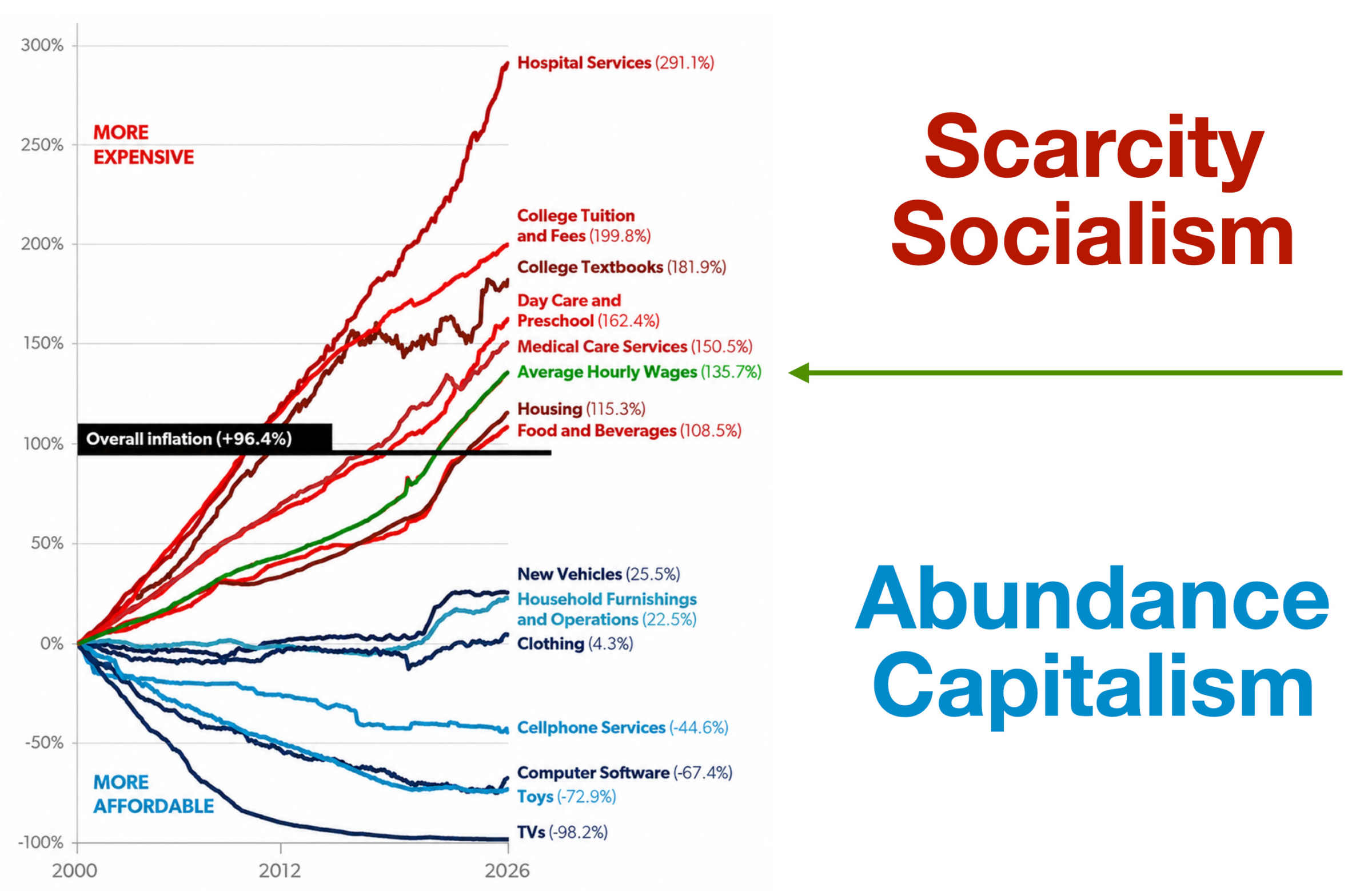
What do products and services above the average hourly wage line have in common? In a word: socialism. They are industries heavily shaped by government intervention. Regulations restrict supply, while subsidies stimulate demand. When supply is constrained and demand is artificially increased, prices rise faster than incomes, making these goods less affordable over time.
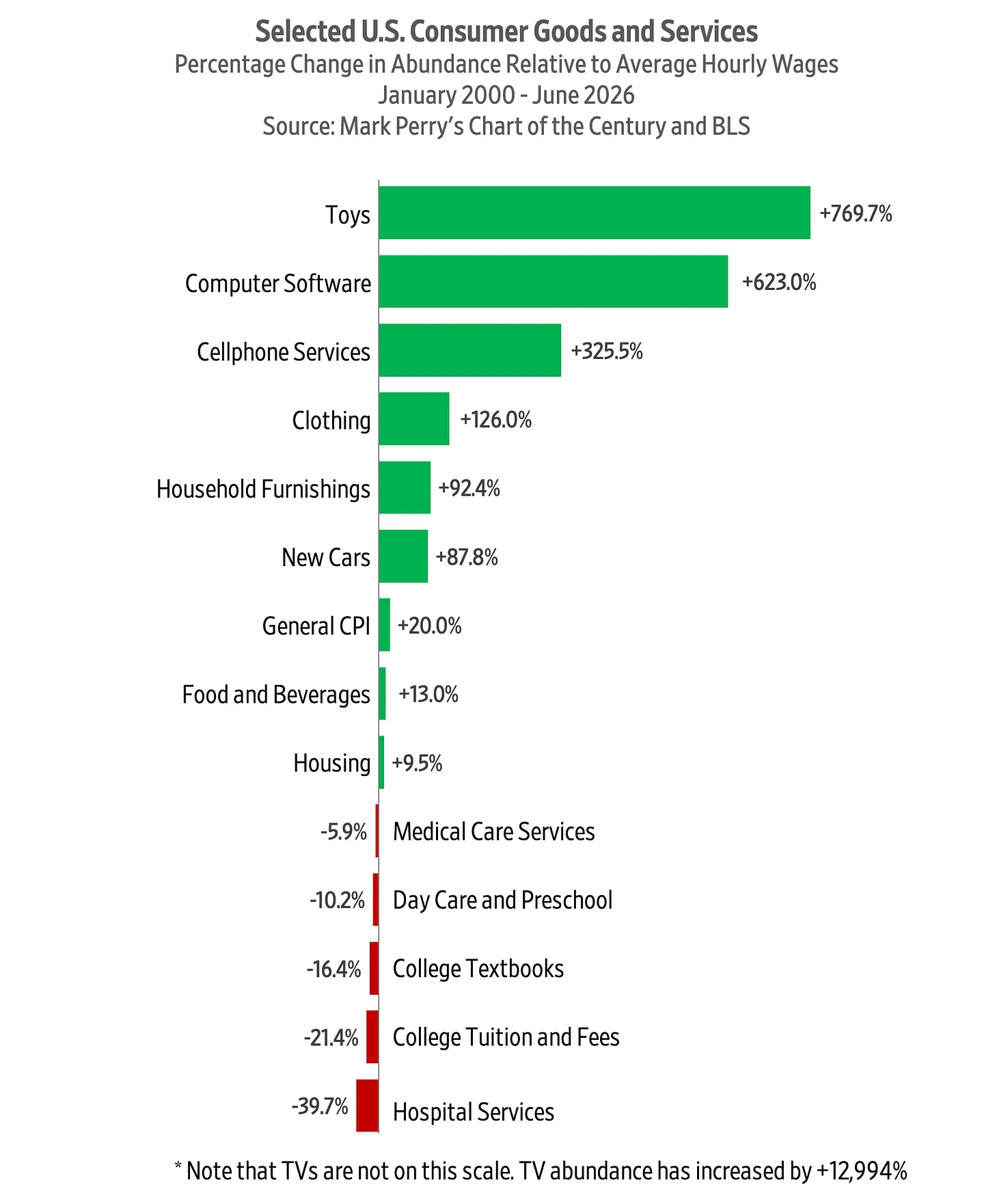
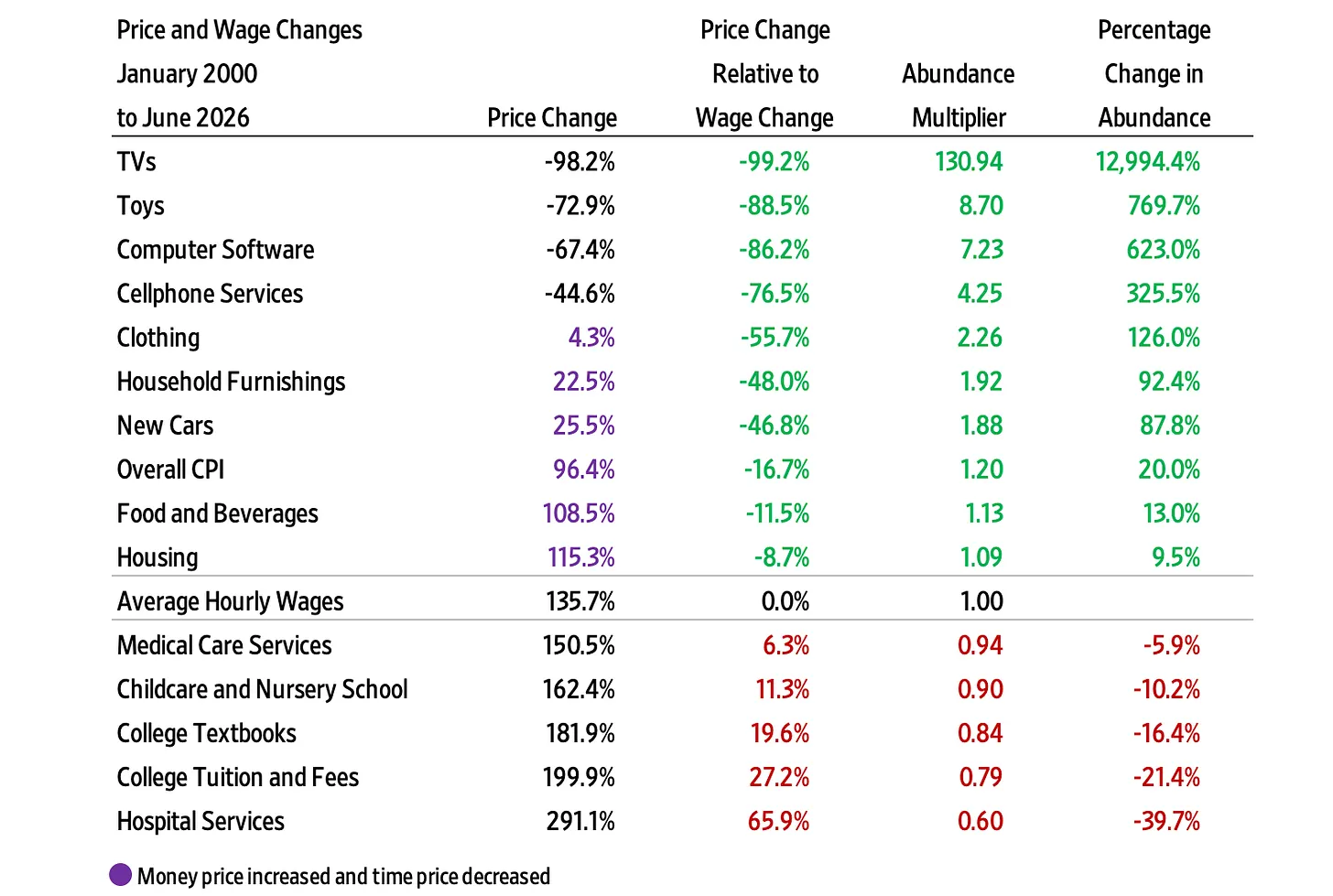
As students of time prices, we compare money prices with average hourly wages. The products and services becoming less affordable are those whose prices are rising faster than wages. We’ve compared the nominal price change of each product to the change in nominal average hourly wages, from which we can show the change in the time price—positive or negative. Next, the time prices are compared over time to measure changes in abundance. This bar chart illustrates these changes:
Here is a table detailing the analysis:
Another problem with increasing prices are third-party payment systems. When someone else is paying, why worry about the price? Cost discipline disappears because the customer is no longer the payer. If the first question someone asks is “Who is your insurance company?” you are probably entering a market where the incentives favor maximizing reimbursement rather than minimizing cost.
Milton Friedman described four ways to spend money in this brilliant two-minute economics lecture:
There are four ways in which you can spend money. You can spend your own money on yourself. When you do that, you really watch out what you’re doing, and you try to get the most for your money. Then you can spend your own money on somebody else. For example. I buy a birthday present for someone. Well, then I’m not so careful about the content of the present, but I’m very careful about the cost. Then, I can spend somebody else’s money on myself. And if I spend somebody else’s money on myself, then I’m sure going to have a good lunch! Finally, I can spend somebody else’s money on somebody else. And if I spend somebody else’s money on somebody else, I’m not concerned about how much it is, and I’m not concerned about what I get. And that’s government. And that’s close to 40% of our national income.
Many people, including Bernie Sanders and AOC, have it backward. If we want goods and services to become more affordable, we need more abundance capitalism and less scarcity socialism. Capitalism rewards innovation, expands supply, and lowers time prices. Socialism does the opposite. It restricts supply, distorts demand, and makes affordability harder to achieve.
Choose wisely.