

Wealth & Poverty Review Become a Superabundance Accelerator: Your First Challenge
Originally published at Gale Pooley's SubstackEvery day, capitalism quietly delivers more for less. Resources aren’t running out; they’re becoming superabundant. But most people still think in money prices, and that’s why they miss the true story.
We buy things with money, but we pay for them with time. That’s why my co-author Marian Tupy and I created the time-price framework in Superabundance. A time price is simply the price of something divided by the hourly wage. It tells you exactly how many hours (or minutes) of work it takes to earn enough to buy it. When time prices fall, abundance rises because an hour of your time now buys more.
Today I’m challenging you to become a Superabundance Accelerator. An accelerator doesn’t just consume abundance—they see it, measure it, celebrate it, and spread the good news. They turn data into hope. They fight the Thanos economics of fear and scarcity with facts.
Your first step is simple. Our Time-Price Calculator makes this easy.
- Pick something you buy.
- Compare the price then vs. now. (Grok and ChatGPT make it pretty easy to find historical prices. You can also look at old Sears, Wards, and Penny’s catalogs here.)
- Let the calculator do the rest.
We’ve preloaded blue-collar hourly wages from 1964 to 2026 from the Bureau of Labor Statistics (BLS), so it will automatically display the rates and compute the time prices and rates of change.
Formula Recap:
- Time Price = Price ÷ Hourly Wage
- Abundance Multiplier = Old Time Price ÷ New Time Price
- Percentage Change in Abundance = Abundance multiplier – 1.
If the Abundance Multiplier is 2.0, you now get twice as much for the same hour of time. If the Abundance Multiplier is 2.0, the Percentage Change in Abundance is 1 or 100 percent.
We also show the compound annual growth rate and the years to double abundance.
That’s it.
Here’s a quick example to get you started:
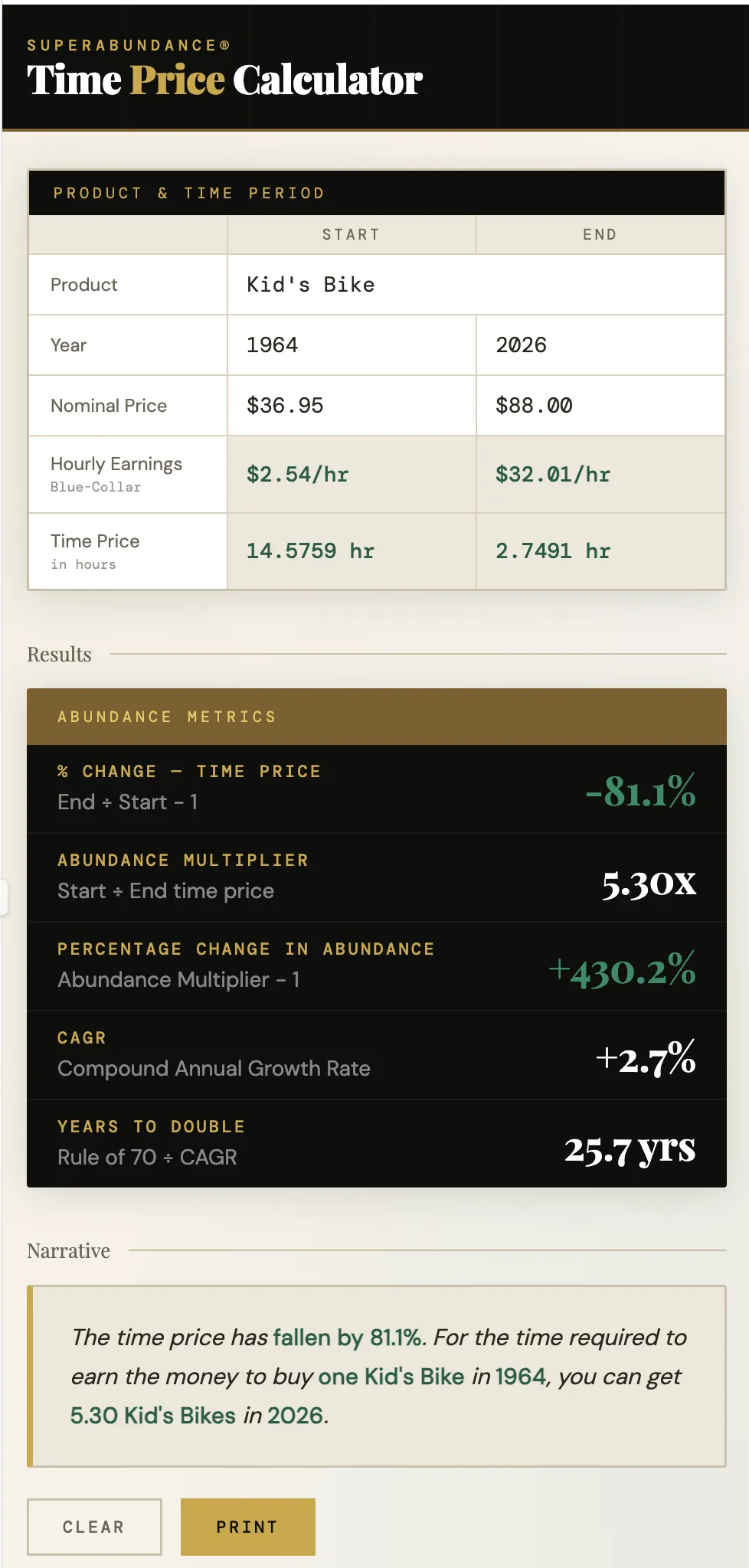
In 1964 a kid’s bicycle cost $36.95 at Sears and the average blue-collar wage was $2.54 an hour, putting the time price at 14.6 hours. Today you can buy one at Walmart for $88.00. Blue-Collar workers are now earning $32.01 an hour putting the time price at 2.75 hours. That’s an 81.1 percent decline in the time price. For the time it took to earn the money to buy one kid’s bike in 1964, a blue-collar worker can buy 5.3 bikes today.
Imagine what you’ll find with your choice. Once you’ve done the math, here’s what Superabundance Accelerators do next:
- Share it with one person who believes things are getting worse.
- Post your results here in the comments and on X (tag me @gpooley).
- Write your own short story or send it to me—I may feature the best ones in a future post.
- Run another one.
The more of us who do this, the faster the world wakes up to the truth: more people + more freedom = more abundance for everyone.
Every drop in a time price is a gift of life—minutes, hours, and years returned to humanity. So pick your product right now. Open the calculator and let it do the math, then come back and tell us what you discovered. We’re not just observers of superabundance. We’re the accelerators. Let’s go.