

Wealth & Poverty Review Housing Amenity Abundance
Originally published at Gale Pooley's Substack1956 was a remarkable year: the Baby Boom was in full swing, Dwight Eisenhower won a second term in the White House, and Elvis Presley topped the charts twice. It was also the year IBM unveiled the world’s first computer hard drive—a one-ton machine, the IBM 305 RAMAC, that could store a grand total of about five megabytes.
It was also the year I was born. Some have suggested it was the golden year for housing, but the facts tell a much different story. Jeremy Horpendahl did an analysis on housing amenities and found the following:
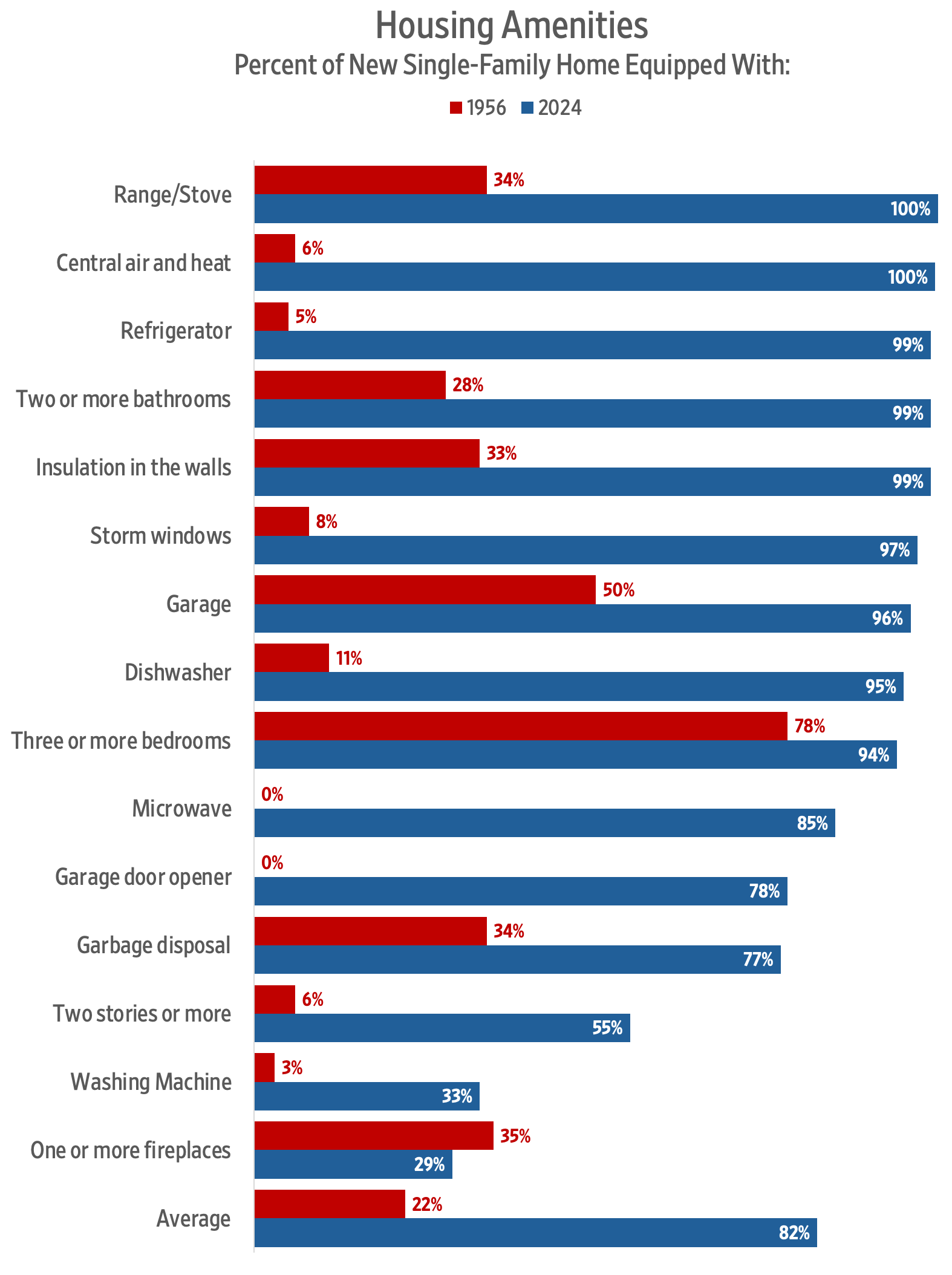
Looks like the only thing we have less of are fireplaces because central heating replaced most of them. On average, only 22 percent of homes had these amenities in 1956, but today 82 percent of them do.
Bigger Houses Fewer Persons
Median home size has more than doubled, rising from about 1,150 square feet in 1956 to roughly 2,210 today. Over the same period, household size has shrunk from 3.3 people to 2.51. The result is a dramatic increase in living space per person—from just 348 square feet in 1956 to about 880 square feet today. That’s 532 more square feet per person, or a 153 percent increase. Had space per person stayed at its 1956 level, the typical home today would measure only about 874 square feet.
Lower Time Price Per Square Foot
The median home cost about $14,500 in 1956—roughly $12.61 per square foot. With average wages at $1.85 an hour, each square foot required 6.82 hours of earning. Today, the median home price is about $420,300, or $190.18 per square foot. However, average wages have risen to $36.53 an hour (before benefits), bringing the time price down to 5.21 hours per square foot. So while the dollar price per square foot has risen fifteen-fold, wages have increased nearly twenty-fold. The result: the time price of housing has fallen by almost 24 percent.
Compared to 1956, we now enjoy 532 more square feet per person, homes packed with 3.7 times more amenities, and all of it for about 24 percent less time per square foot.
Tip of the Hat: Jeremy Horpendahl.